Tulas came in after their previous creative partner stalled out. Two months later, one campaign was pulling $250K in spend at a 40% hook rate on the same system that ran Sprint 1.
$250,454 spent on a single campaign with a 40.07% hook rate. Same creative system that ran the test.
Two weeks in, the system had already hit KPI. $54,517 spent, 1.88x ROAS, $23.64 CPA. They renewed immediately.
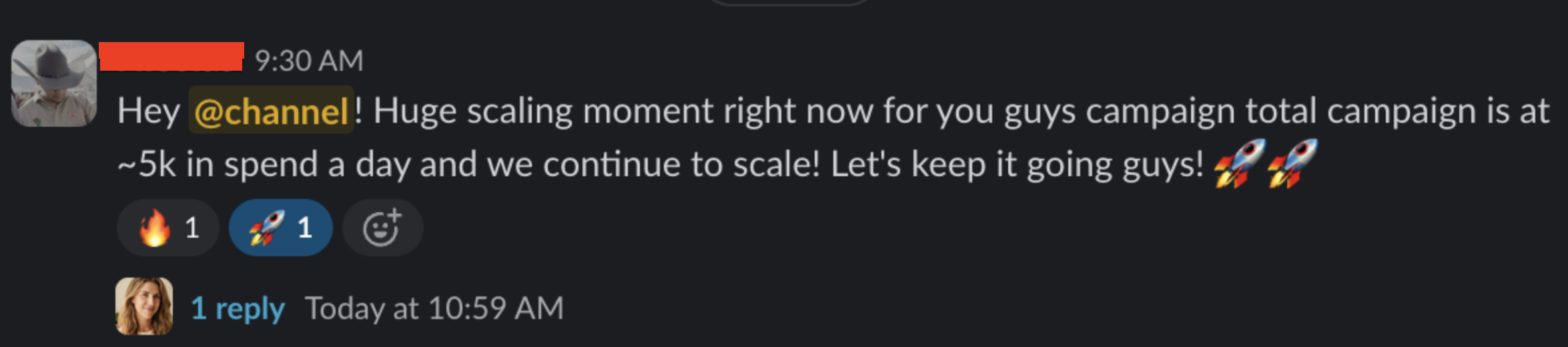
Team member name blurred for privacy.
Tulas came in with a distinctive product but ad creative that wasn't cracking. Their previous partner had been shipping ad-hoc briefs with no testing framework, so nothing was compounding week over week. Budget wasn't the issue. They needed the strategy layer that had never been built.
Most agencies skip this part because it's slow and the client can't see it happening. We mapped every motivator that could realistically drive a Tulas purchase, pulling from customer reviews, comment threads, competitor ad libraries, and cross-brand signals from the other accounts we run.
Then we structured those motivators into a testing framework built directly on Meta's Creative Diversification Playbook: one motivator per concept, three structurally different format variations, shipped weekly. The algorithm scales creative that gives it real diversity across formats, not three hooks on the same footage. That's the whole mechanic.
Sprint 1 hit numbers Tulas hadn't seen with their previous partner, so they renewed on the spot. Winners got iterated. Losers got cut. By the end of month two, that one campaign was doing $250K in spend and still scaling.
The Strategy Engine works when there's a real product, real footage, and a team that can execute.
Book a Strategy Call →

